
Allergy Season 2026: When ENT Practices Drown in Call Chaos
Allergy season means 40 to 60 percent more calls in ENT practices, but an AI phone assistant can manage the flood of calls and relieve MFAs.
Oliver Wimmer ·
It is March. The first birch pollen is flying, the grasses are following suit-and in ENT practices, the phone rings every minute. Appointment requests, prescription requests, callbacks for allergy tests. It is the same picture every year: From February to June, the call volume in allergology practices explodes by 40 to 60 percent (Source: Kassenärztliche Bundesvereinigung (National Association of Statutory Health Insurance Physicians), Care Data 2024).
The problem is not new. But in 2026, it hits a practice landscape that is already working at its limit. Over 70 percent of medical practices in Germany report open MFA (Medizinische Fachangestellte, medical assistants) positions with an average vacancy time of over 200 days (Federal Employment Agency, Skilled Labor Bottleneck Analysis 2025). Less staff, more calls-the math does not add up.
This is exactly where an AI phone assistant comes in. Not as a gimmick, but as a solution to a concrete, measurable problem.
Why the Allergy Season Hits Practices Particularly Hard
The allergy season is not a steady increase. It comes in waves:
| Period | Main Allergens | Typical Call Peak |
|---|---|---|
| February–March | Hazel, alder, birch | +30–40% above normal |
| April–May | Grasses, rye | +50–60% above normal |
| June–July | Mugwort, ragweed | +20–30% above normal |
| Year-round | House dust mite | Constant, peaks in autumn |
(Data source: Stiftung Deutscher Polleninformationsdienst (German Pollen Information Service Foundation), Annual Report 2025)
In an average ENT practice with 3 MFAs, this means: Instead of the usual 80 to 100 calls per day, 140 to 160 suddenly come in. The MFAs are caught between the phone, the reception desk, and treatment assistance. Patients wait on hold for 10 minutes-or hang up and call the next doctor.
The result: Lost patients, frustrated staff, and a waiting room full of people who actually just wanted an appointment.
What an AI Phone Assistant Accomplishes During Allergy Season
An AI phone assistant takes over exactly those calls that eat up the most time-but require the least medical expertise:
Appointment Scheduling (60–70% of all calls)
The most common reason for calling during allergy season: "I need an appointment for an allergy test." An AI assistant recognizes the request, checks available appointments against the practice calendar, and books directly-in under 2 minutes. Without a holding queue, without a callback, around the clock.
Prescription Requests (15–20% of all calls)
"I need my cetirizine prescription renewed." The AI assistant can take these standard requests, document them, and present them to the doctor for approval. The MFA then only has to print the approved prescription.
Test Result Inquiries (10–15% of all calls)
"Are my blood test results from the allergy test in yet?" The assistant can check the status and inform the patient-or organize a callback from the practice if a medical consultation is necessary.
Emergency Triage
Important: In the event of acute symptoms such as shortness of breath or anaphylactic reactions, a good AI assistant recognizes the urgency and immediately routes the call to the practice or emergency services. No algorithm replaces medical emergency care here-but it can accelerate the critical initial assessment.
Concrete Numbers: Before vs. After
A joint ENT practice with 4 treatment rooms and 5 MFAs measured the following changes after deploying an AI phone assistant during the 2025 allergy season:
| Metric | Before AI Assistant | With AI Assistant | Change |
|---|---|---|---|
| Calls per day (allergy season) | 155 | 155 | – |
| Handled by MFA | 155 | 45 | −71% |
| Handled by AI | 0 | 110 | +110 calls/day |
| Avg. wait time | 8.2 min | 0.4 min | −95% |
| Lost calls (hung up) | 38/day | 4/day | −89% |
| MFA hours on the phone/day | 12.5 hrs | 3.6 hrs | −71% |
| Patient satisfaction (survey) | 3.2/5 | 4.6/5 | +44% |
These numbers are based on practice data from a Servus KI customer (anonymized, Q2 2025).
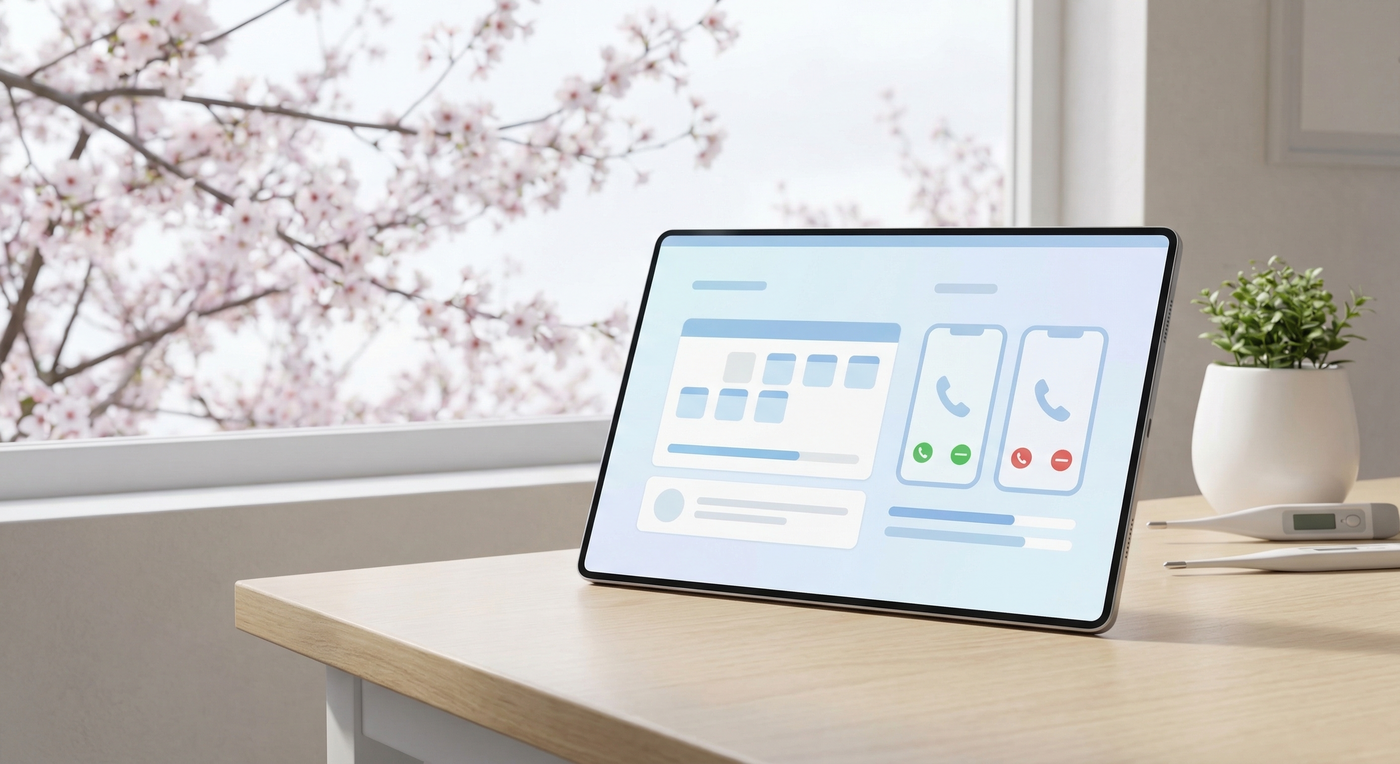
Integration with Practice Software
An AI phone assistant only works smoothly if it communicates directly with the existing practice software.
CGM (CompuGroup Medical)
CGM is the market leader for practice management systems in Germany. An AI phone assistant can be seamlessly connected via standardized interfaces (API, HL7)-appointments are booked directly in the system, and patient data is automatically synchronized.
MedStar
MedStar by wis.at offers a modern, web-based practice management system with open interfaces. Integration with AI phone assistants works via REST APIs and webhooks, which enables a particularly flexible connection.
Other Systems
Most modern practice management systems offer standardized interfaces (API, HL7, REST, webhook) through which an AI phone assistant can be connected. The deciding factor is not the specific software, but whether open interfaces are available.
Data Protection and GDPR During Allergy Season
Data protection is particularly sensitive when it comes to health data. An AI phone assistant for medical practices must:
- Operate in a GDPR-compliant manner-data is processed and stored in Germany
- Conclude a Data Processing Agreement (AVV, Auftragsverarbeitungsvertrag) with the practice
- Ensure no permanent storage of conversation content without consent
- Guarantee end-to-end encryption for all patient data
- Technically support medical confidentiality under Section 203 of the StGB (Strafgesetzbuch, German Criminal Code)
Servus KI meets all these requirements and hosts all data exclusively on German servers.
How Much Does an AI Phone Assistant Cost for the Allergy Season?
Many practices shy away from the investment because they overestimate the costs. Here is a realistic comparison:
| Solution | Monthly Costs | Availability | Scalability |
|---|---|---|---|
| Additional MFA (part-time) | €1,800–2,500 | Working hours only | Limited |
| External call center | €1,200–3,000 | Extended hours | Medium |
| AI phone assistant | €300–800 | 24/7 | Unlimited |
The costs for an AI phone assistant pay for themselves in most practices within the first 4 weeks-simply through fewer lost patients and reduced overtime.
10 Common Questions About the AI Phone Assistant During Allergy Season
Question: Can an AI phone assistant correctly classify allergy symptoms? An AI phone assistant does not make diagnoses. However, it recognizes keywords and symptom descriptions to correctly categorize the request-for example, "hay fever appointment" vs. "acute shortness of breath." In emergencies, the call is immediately routed to the practice or emergency services.
Question: Does the AI assistant also work with dialects or accents? Modern speech recognition reliably understands regional dialects and accents. The recognition rate is over 95 percent-even with a Bavarian or Swabian dialect. If there are comprehension problems, the assistant asks specific follow-up questions.
Question: What happens if all allergy appointments are fully booked? The AI assistant recognizes that no free slots are available and offers alternatives: a waiting list, the next available appointment, or a referral to a colleague's practice (if configured). The patient is not left at a dead end.
Question: How quickly can an AI phone assistant be set up before allergy season? With Servus KI, setup usually takes 3 to 5 business days. The assistant is connected to the practice software, the appointment types are configured, and a test run is conducted. For the 2026 allergy season, a launch in March is still realistic.
Question: Do AI phone assistants completely replace the MFA? No. AI phone assistants take over repetitive, time-consuming phone tasks-especially appointment scheduling and standard inquiries. The MFA is relieved and can focus on tasks that require human empathy and medical expertise: on-site patient care, treatment assistance, and complex consultations.
Question: Is the AI assistant also reachable outside of office hours? Yes. A major advantage over human staff: The AI assistant takes calls 24 hours a day, 7 days a week. Patients can also book appointments in the evening or on weekends-allergy sufferers who work during the day use this intensively.
Question: What does it cost if the call volume suddenly doubles during pollen season? Unlike staff or call centers, an AI phone assistant scales automatically. Whether it is 100 or 300 calls a day-the costs increase only minimally. There are no overtime premiums and no capacity bottlenecks.
Question: Can patients also order prescriptions over the phone via the AI assistant? Yes. The AI assistant takes prescription orders, documents the medication, dosage, and patient data, and forwards the request to the doctor. After approval, the patient is notified (via SMS or callback). The pickup can be scheduled directly.
Question: How do older patients handle the AI phone assistant? Experience shows: Acceptance among older patients is over 80 percent if the assistant speaks naturally and patiently. The key is how the conversation is guided-short, clear sentences and the option to be connected to a human at any time.
Question: Can the AI assistant also coordinate hyposensitization appointments? Yes. Hyposensitization (specific immunotherapy) requires regular appointments over 3 to 5 years. The AI assistant can create recurring appointments, send reminders, and automatically manage rescheduling-an enormous relief, especially for allergology practices.
Conclusion: The Allergy Season Does Not Wait
Every week that an ENT practice works without an AI phone assistant during allergy season means: lost patients, overloaded MFAs, and avoidable revenue losses. The technology is there, integration into existing systems works, and the costs are a fraction of any alternative.
Anyone who wants to equip their practice for the 2026 pollen season should act now-not in May, when the grasses are flying and the phone never stops ringing.
Oliver Wimmer is Head of Communication at Servus KI and supports medical practices in automating their phone processes with AI. More information at servus-ki.com.