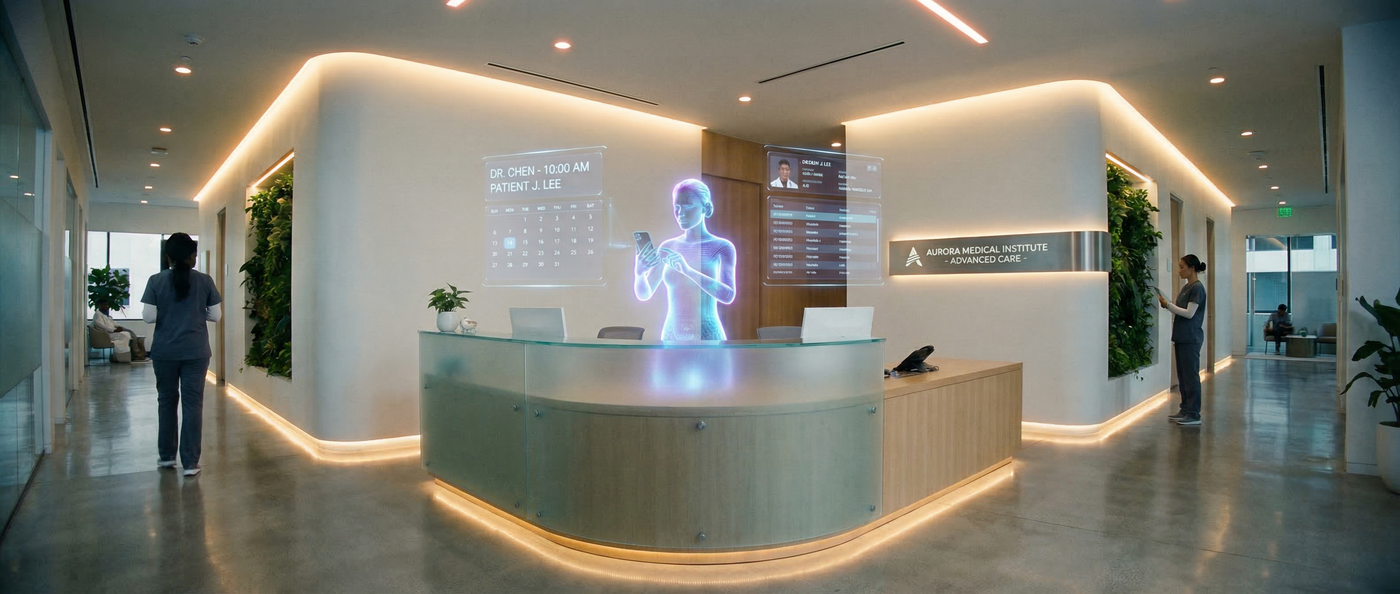
HIMSS 2026: Agentic AI Enters the Medical Practice – What German Practices Need to Know Now
HIMSS 2026 shows agentic AI revolutionizing medical practice phones, and with Amazon and Google investing billions, here is what it means for German practices.
Oliver Wimmer ·
24,000 trade visitors, 1,400 exhibitors, one buzzword everywhere: agentic AI. At HIMSS 2026 in Las Vegas (March 9–12), the healthcare industry showed where things are heading-and this time, it is not an empty promise. Amazon, Google, and dozens of startups presented concrete products that relieve medical practices of exactly the tasks that consume the most time: phone calls, appointment scheduling, and administration.
For German practices, the question arises: Is this just a US trend, or is it coming to us as well?
The short answer: It is already here.
What is agentic AI-and why is it more than a chatbot?
The difference between a traditional AI chatbot and agentic AI is simple: A chatbot answers questions. An AI agent completes tasks.
In concrete terms, this means an AI agent answers a call, identifies the patient's request, checks the calendar, books an appointment, sends a confirmation via text message, and documents everything in the practice management software. Without an MFA (Medizinische Fachangestellte, or medical assistant) needing to intervene. Without putting anyone on hold. Around the clock.
The journal Nature Digital Medicine defines agentic AI as "AI systems that operate autonomously to achieve defined clinical goals"-as opposed to passive software that only responds to inputs (Source: Nature Digital Medicine, March 2026).
HIMSS 2026: The three biggest announcements
Amazon Connect Health: The tech giant enters the market
At HIMSS, AWS introduced Amazon Connect Health: an AI system specifically for healthcare that covers five core functions via voice AI:
- Patient verification – automatic identity checks on the phone
- Appointment management – natural language, available 24/7, direct calendar integration
- Clinical documentation – automated doctor's letters and summaries
- Medical coding – accelerating billing
- Insurance verification – clarifying coverage in real time
Initial customers such as Amazon One Medical, Netsmart, and Greenway Health are already using the system (Source: AWS Blog, March 2026).
Google: From data management to AI agents
Google argues that healthcare needs to make the leap: away from merely storing digital records, and toward AI agents that act based on this data. Scheduling, claims, documentation, patient communication-these are all areas where Google considers agentic AI ready for deployment (Source: PYMNTS, March 9, 2026).
UnityAI: $8.5 million for the "last mile"
The startup UnityAI has raised $8.5 million to bring AI agents into medical practices. The numbers are impressive:
- 300,000 patient interactions per month across hundreds of practice locations
- 90% of all appointment bookings handled without human staff
- Escalation rate below 6% – only one in 17 cases requires a human
- 65% staff savings in the supported areas
UnityAI CEO Edmund Jackson sums it up: "What holds healthcare back rarely happens in the exam room-but rather in everything that determines whether the patient even gets there in the first place." (Source: HIT Consultant, March 4, 2026)
What does this mean for German medical practices?
The US figures are impressive. But everyday practice life in Germany has its own challenges:
The phone problem is universal
An average Hausarztpraxis (primary care practice) in Germany handles 80 to 120 calls per day. During the current allergy season, ENT practices receive up to 160. At the same time, MFA positions remain unfilled for an average of over 200 days (Federal Employment Agency, Skills Shortage Analysis 2025).
The math is simple: fewer staff + more calls = lost patients.
GDPR instead of HIPAA-but the principle is the same
While US practices are bound by HIPAA, the GDPR applies in Germany. The data protection requirements are even stricter. But the basic principle is identical: AI phone assistants that work with patient data need clear compliance rules, data processing agreements, and technical security measures.
Good news: German providers of AI phone assistants are already prepared for this. The technology is GDPR-compliant, and the data remains in the EU.
Practice software integration is solvable
Amazon Connect Health integrates with the US systems Epic and Cerner. In Germany, the systems are called CGM, MedStar, DocDena, or Tomedo. The challenge is similar: the AI agent must communicate with the practice calendar and patient management system.
Via standardized interfaces (API, HL7, REST, Webhook), this is already possible today-not just in the future.
Agentic AI vs. traditional AI phone assistant: The crucial difference
| Feature | Traditional chatbot | AI phone assistant (agentic AI) |
|---|---|---|
| Communication channel | Text (chat, email) | Voice (phone) |
| Scope of action | Answers questions | Books appointments, sends text messages, documents |
| Availability | During opening hours | 24/7, including nights and weekends |
| Escalation | Always forwards the call | Handles 85–90% independently |
| Integration | Standalone | Directly into practice software |
| Hold queue | As usual | None – immediate answer |
The EU AI Act card: Trust through transparency
Starting in August 2026, the EU AI Act will take full effect. Article 50 requires that patients on the phone be informed when they are speaking with an AI. That sounds like a hurdle, but it is an opportunity.
Practices that communicate proactively-"Our AI assistant will take your call and book an appointment directly for you"-build trust. Transparency is not a competitive disadvantage; it is the hallmark of reputable providers.
Conclusion: HIMSS 2026 shows the future-but it is already a reality in Germany
The billion-dollar investments by Amazon, Google, and startups like UnityAI confirm that AI phone assistants for medical practices are no longer an experiment. They are the logical answer to the MFA shortage, the flood of phone calls, and rising patient expectations.
The difference: In the US, the infrastructure is currently being built. In Germany, there are already functioning solutions-GDPR-compliant, integrated into practice software, and ready for immediate use.
The question is no longer if, but when.
FAQ
What is agentic AI in healthcare?
Agentic AI refers to AI systems that independently complete multi-step tasks in medical practices-such as booking appointments, taking prescription requests, or checking the status of test results-without human staff needing to intervene.
Does agentic AI also work in German medical practices?
Yes. The technology behind AI phone assistants is already in use in German practices. It operates in a GDPR-compliant manner and integrates into common practice software such as CGM, MedStar, and DocDena.
What percentage of calls can an AI phone assistant handle?
According to current data from UnityAI (March 2026), 90% of all appointment bookings are handled without human staff. In German practices, the rate is typically between 70% and 85%, depending on the medical specialty.
Is an AI phone assistant GDPR-compliant?
Yes, if the provider meets the requirements: an Auftragsverarbeitungsvertrag (data processing agreement), data processing in the EU, encrypted transmission, and transparent patient information in accordance with Article 50 of the EU AI Act.
What did HIMSS 2026 bring for medical practices?
HIMSS 2026 (Las Vegas, March 9–12) showed that agentic AI has arrived in healthcare. Amazon, Google, and startups like UnityAI presented concrete products for appointment scheduling, documentation, and patient communication.
How much does an AI phone assistant cost for a medical practice?
The costs vary depending on the provider and practice size. Typically, they range between 200 and 500 euros per month-significantly cheaper than an additional MFA position (which averages 2,800 to 3,200 euros gross per month).
Does an AI phone assistant replace the MFA?
No. The AI assistant takes over repetitive phone tasks such as appointment scheduling and prescription requests. MFAs are still needed for personal patient care, medical assistance, and complex inquiries-but they are no longer permanently stuck on the phone.