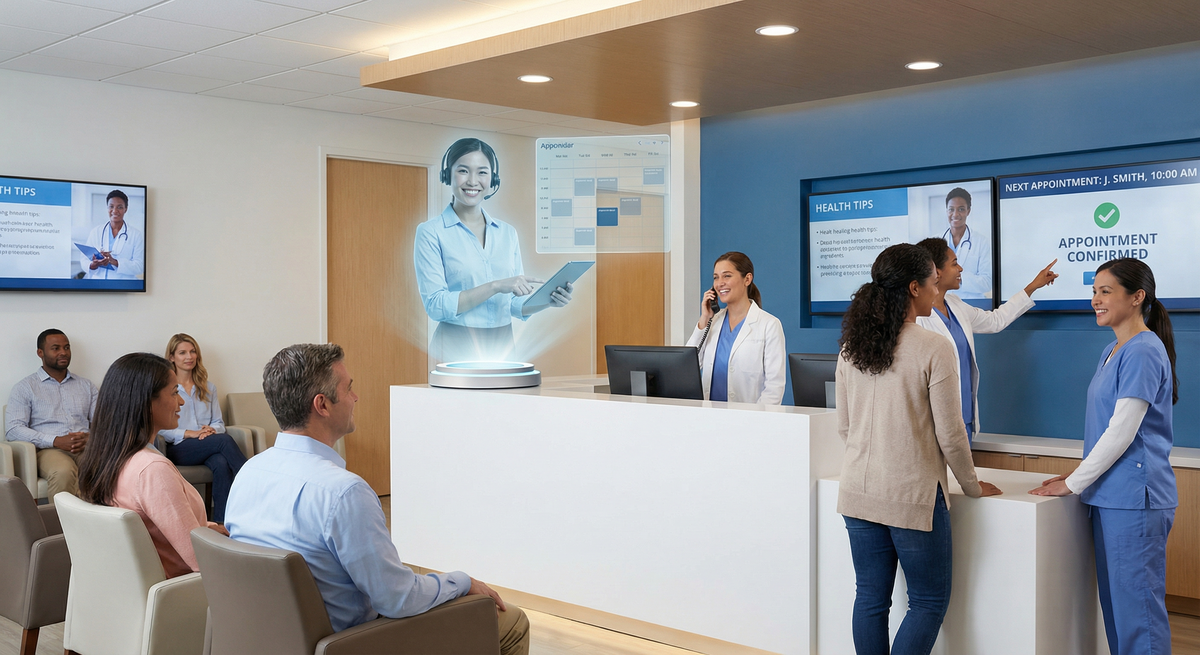
How a general medical practice saves 16 hours of phone time per week
Real data: How a Munich general medical practice with 8,500 patients reduced its phone time from 20 to 4 hours, including ROI, implementation, and results.
Oliver Wimmer ·
How a general medical practice saves 16 hours of phone time per week
The result at a glance
A general medical practice in Munich with three doctors and 8,500 patients reduced its weekly phone time from 20 hours to 4 hours – a saving of 16 hours per week. The investment in an AI phone assistant paid for itself within three months. This field report shows exactly how this was achieved.
Why traditional practice telephony no longer scales
The problem before the transition
The general medical practice Dr. Schmidt (name changed) in Munich faced an everyday but critical challenge: The phone rang continuously. Between patient consultations, vaccinations, and bandage changes, the four MFAs (medizinische Fachangestellte, medical assistants) constantly had to jump to the phone.
Concrete figures before the transition:
- 180 calls per day on average
- Peak times: up to 40 calls per hour (8:00–10:00)
- Average call duration: 4–6 minutes
- Callbacks due to busy signals: approx. 30 per day
- Total phone time: 20 hours per week (0.5 full-time equivalents)
The consequences: Overworked staff, longer on-site wait times, increased turnover among MFAs, and frustrated patients who were stuck on hold for long periods.
The solution: AI phone assistant as digital reinforcement
System requirements
The practice defined clear criteria for a digital solution:
- GDPR-compliant data processing (hosting in Germany)
- Complete appointment scheduling without human intervention
- Integration into MedStar practice software (existing infrastructure)
- 24/7 availability for appointment requests outside consultation hours
- Natural conversation flow for older patients and dialects
Implementation process
Weeks 1–2: Technical integration
- Connection via SIP interface to the existing telephone system
- Bidirectional interface to the MedStar system for real-time calendar queries
- Automatic patient identification based on phone number
Week 3: Training and fine-tuning
- Teaching practice-specific appointment rules (e.g., double appointments for vaccinations, buffer times for emergencies)
- Adapting the conversation style to the target audience (older patients, multilingualism)
Week 4: Go-live with supervised operation
- Parallel operation: AI assistant handles 50% of calls
- Monitoring by the practice team
- Gradual increase to 100%
The results after 90 days
Quantitative success metrics
| Metric | Before | After | Improvement |
|---|---|---|---|
| Calls/day | 180 | 45 (complex cases only) | −75% |
| Phone time/day | 4 hours | 48 minutes | −80% |
| Callbacks due to busy signal | 30/day | 0 | −100% |
| Appointments outside hours | 0/day | 12/day | New |
| Wait time on the phone | 4:30 min. | 0:45 min. | −83% |
Time savings calculation:
4 hours daily × 5 days = 20 hours before
48 minutes daily × 5 days = 4 hours after
Net savings: 16 hours per week
Financial profitability (ROI)
Monthly costs:
- AI phone assistant: approx. 400 €
Monthly savings:
- Personnel costs (0.5 full-time equivalent MFA): approx. 1,800 €
- Net savings: approx. 1,400 €/month
- Annual savings: approx. 16,800 €
Amortization period: 3 months
Qualitative improvements
For the practice team:
- More focused workflows without constant interruptions
- Higher employee satisfaction – no more "phone stress minutes"
- More time for patients – longer conversations, better consultation
- Reduced turnover – fewer repetitive, stressful tasks
For the patients:
- Immediate reachability – no more holding queues
- 24/7 appointment booking – especially popular with working professionals (21:00–23:00)
- Patient, clear communication – no hectic background noise
For the practice owners:
- Growth without personnel expenses: +200 patients without additional hiring
- Image as an innovative practice – positive patient reviews
- Sustainable relief – not a temporary solution, but a permanent optimization
FAQ: Frequently asked questions about AI telephony in medical practices
Can older patients handle the system?
Yes. Experience shows that patients over 70 years old perceive the assistant as "polite and patient" – in contrast to overworked practices where they feel rushed. The system uses clear, simple language without medical jargon.
What happens with complex medical inquiries?
The AI assistant recognizes its limits and automatically forwards calls in cases of:
- Acute symptoms ("I have severe chest pain")
- Medication side effects ("I have a rash from the new pill")
- Prescription renewals for prescription-only medications
- Emotionally charged conversations
→ Immediate forwarding to human staff with context transmission
Is the connection to the practice software complicated?
No. Integration takes place via standardized interfaces (API, HL7, REST, Webhook) and is compatible with all common practice software systems.
Duration of technical setup: 1 business day
How secure is the patient data?
- Encrypted data transmission (TLS 1.3)
- No storage of sensitive conversation content
- Hosting exclusively in German data centers
- GDPR-compliant processing with a data processing agreement
- Complete audit logs of all system accesses
The technical architecture at a glance
1. Speech recognition (ASR)
- Speech-to-text with medical vocabulary
- Dialect and accent tolerance for Bavaria, Swabia, Saxony
- Noise cancellation for better recognition rates
2. Natural language processing (NLP)
- Intent recognition: Distinguishing between appointment requests, prescription requests, emergencies
- Context awareness: Multi-step conversations ("Would you like Tuesday or Wednesday?")
- Entity extraction: Automatic capture of names, dates, times
3. Practice software integration
- Real-time calendar query with blocking of free slots
- Patient identification via phone number (reverse search)
- Automatic appointment confirmations via SMS
4. Intelligent conversation flow
- Appointment optimization: Clustering by medical specialty and treatment duration
- Emergency detection: Keywords like "pain," "emergency," "unwell" trigger immediate forwarding
- Waitlist management: Automatic moving up in case of cancellations
The practice software market: An overview
MedStar – The solution in use
The practice presented in this case study relies on MedStar (developed by WIS, Websuche Informations Systeme GmbH from Austria, https://www.wis.at). MedStar is one of the leading practice management systems in the DACH region and is characterized by its modular design and open interface architecture.
MedStar at a glance:
- Area of application: General medicine, specialist practices, and MVZs (Medizinische Versorgungszentren, medical care centers)
- Special feature: Strong networking capability and supported data transmission via REST API
- Distribution: Several thousand installations in Austria, Germany, and Switzerland
Why MedStar is suitable for AI integration: The open API structure of MedStar enables seamless integration of external service providers like AI phone assistants. Real-time access to appointment calendars and patient records (GDPR-compliant) is technically straightforward to implement, which enabled the rapid implementation in the practice described here.
CompuGroup Medical (CGM) – The market leader
Alongside MedStar, which was used in this practice, CompuGroup Medical (CGM) is the dominant player in the German practice software market. With over 40,000 installed systems, CGM covers around 35% of all German medical practices.
CGM products at a glance:
- CGM MEDISTAR: Focus on general medicine and internal medicine practices
- CGM M1: For medium to large practices and MVZs
- CGM ALBIS: Specialized for psychotherapeutic practices
Why CGM is relevant: The integration of AI phone assistants into CGM systems is essential due to their high market presence. CGM's API interfaces enable bidirectional data transmissions, which are necessary for real-time appointment scheduling.
Trend: Traditional practice software providers like CGM are increasingly opening up to third-party integrations – an advantage for practices that want to use AI solutions as a supplement without completely rebuilding their existing IT infrastructure.
Lessons Learned: What we learned from the implementation
1. Change management is crucial
The biggest hurdle was not technical in nature, but acceptance within the team. Recommendation: Involve the practice staff early on and communicate the relief, not the replacement.
2. Fine-tuning takes time
The first two weeks required daily adjustments to the conversation flow. After 30 days, the system ran almost autonomously.
3. Patient acceptance exceeds expectations
Fear: Older patients would complain. Reality: The 24/7 reachability was received overwhelmingly positively.
4. Hybrid approach is the key
The AI assistant handles 80% of standard inquiries (appointments, information, reminders). The remaining 20% of complex cases are handled by humans – with full focus and time.
Conclusion: The future is hybrid
The AI phone assistant does not replace the practice team – it frees them from repetitive routine tasks. The 16 hours of weekly time savings at Dr. Schmidt's practice were redirected into:
- 40% direct patient care – longer conversations, more individualized consultation
- 30% quality management – documentation, hygiene measures, continuing education
- 30% team development – supervision, team building, process optimization
The decisive result: A practice team that can once again focus on what matters – the medical care of the patients.
Next steps for your practice
Test Servus KI for free:
- No setup fee
- 14-day trial period with no obligation
- Full data protection according to the German GDPR
- Integration into your existing practice software
Further reading:
- AI in the medical practice: Legal framework 2026
- Comparison: AI phone assistant vs. human MFA
- Implementation guide: How to succeed with the rollout
Internal links:
About the author
Oliver Wimmer
Head of Communication, Servus KI
Oliver leads communication at Servus KI and guides medical practices through digital transformation. He combines technical expertise with practical consulting and supports practices in implementing innovative communication solutions.
Do you have questions about this case study or would you like to have your own practice analyzed? Contact us at [email protected] or give us a call – naturally, our own AI assistant will answer your call.