
MFA Shortage: How Practices Compensate for 3 Positions with AI Phone Assistants
The skilled labor shortage among MFAs costs practices up to €165,000 per year, but an AI phone assistant can take over the workload of three positions.
Oliver Wimmer ·
200 Days of Vacancy, Zero Applications - Sound Familiar?
How long has your last MFA (medical assistant) position been vacant? Two months? Four? Half a year? You are not alone in this. According to the Bundesagentur für Arbeit (Federal Employment Agency), medical assistants are among the top 10 shortage occupations in Germany. Over 70% of practices report that they cannot fill open MFA positions - and when they do, it takes more than 200 days on average (Source: Bundesagentur für Arbeit, Fachkräfteengpassanalyse 2025).
Over half a year without reinforcements at the front desk, on the phone, in patient care. What happens during this time? The remaining MFAs work at their limit. And eventually, the next one resigns.

What Does a Vacant Position Really Cost You?
Let's run the numbers. An MFA costs the employer around €45,000 to €55,000 per year - including social security contributions, vacation, and continuing education. Sounds like a lot? The true costs of a vacant position are significantly higher. Have you ever asked yourself what is slipping through the cracks?
- Overtime for the remaining MFAs: Surcharges, sick leave, increasing turnover
- Lost patients: Anyone waiting on hold for 20 minutes will look for another doctor - do these patients ever come back?
- Recruiting costs: Job ads, headhunters, onboarding - easily €5,000–10,000 per hire
- Burnout risk: What happens when your best MFA can no longer cope?
Conservatively estimated, the staffing crisis costs an average practice €120,000 to €165,000 per year - due to three vacant or half-staffed positions. Can you afford this in the long run?
Where Does All the Time Actually Go?
This is where it gets interesting: According to the KBV (National Association of Statutory Health Insurance Physicians) practice barometer, MFAs spend 30 to 50 percent of their working hours on the phone. For a full-time position, that is 12 to 20 hours per week. For what exactly? Appointment scheduling, prescription requests, referrals, and the same recurring questions about opening hours.
Ask yourself: Does it really require a trained professional to read out the consultation hours for the hundredth time? Or to book a routine appointment?
Conversely, this means: A system that takes over the phone work compensates for the workload of around 1.5 to 3 MFA positions - depending on the practice size and call volume.
What If Your MFAs Had Time for Patients Again?
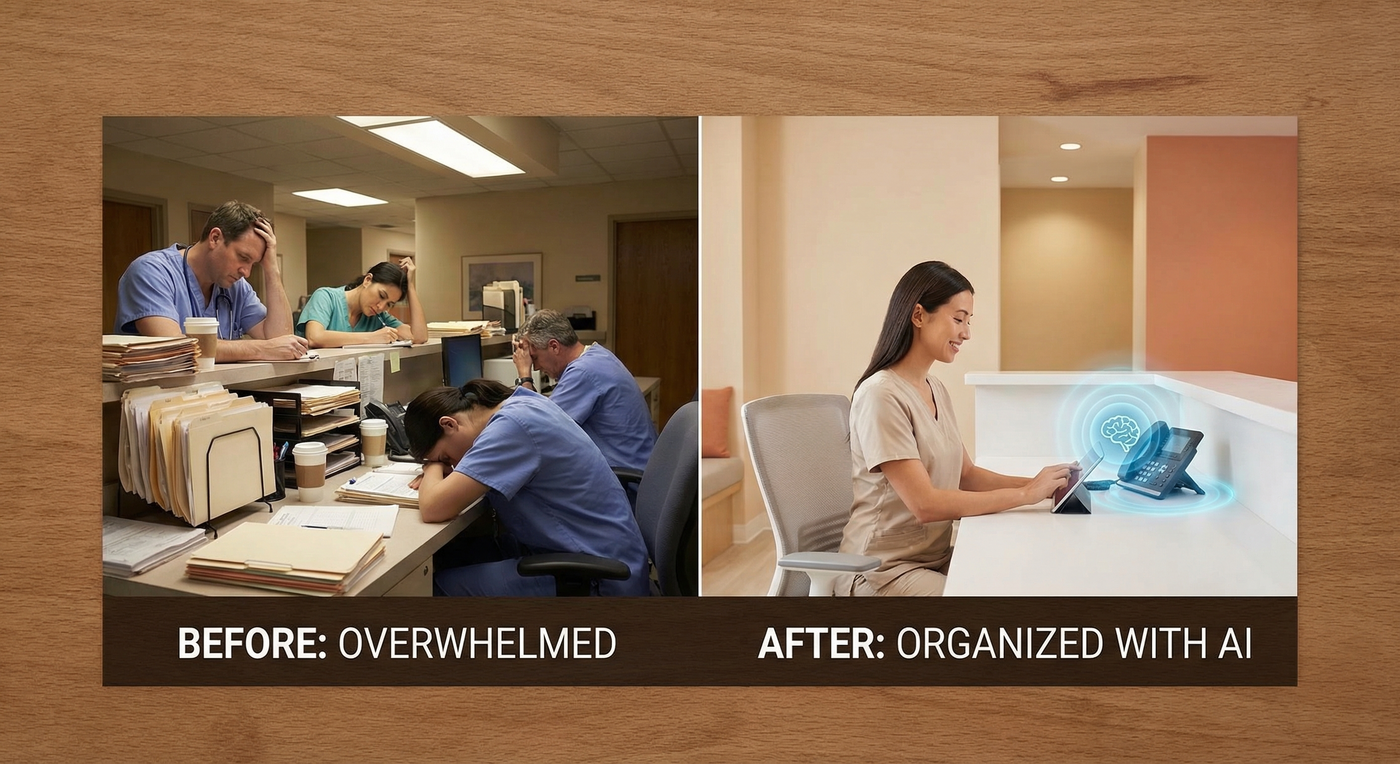
An AI phone assistant like Servus KI does not replace an MFA. It takes over the repetitive, time-consuming tasks that keep qualified professionals from their actual work. Imagine this: Your MFAs arrive at the practice in the morning - and instead of immediately rushing to the ringing phone, they can take care of the patients on site.
| Task | Without AI | With AI Assistant |
|---|---|---|
| Appointment scheduling | MFA on the phone, 3–5 min/call | Automatic, 24/7, under 60 seconds |
| Prescription requests | MFA takes down, forwards | Automatically recorded and documented |
| Opening hours/Directions | MFA answers manually | Immediate automatic information |
| Callback requests | Slips of paper, Post-its, forgotten notes | Digitally recorded, prioritized, delivered |
| Wait time for patients | 5–20 minutes on hold | No wait time, immediate answering |
The result: Your MFAs once again have time for what they were trained to do - patient care, assistance, lab work, personal consultation. Isn't that actually the reason they chose this profession?
Is It Worth It? The Calculation in Comparison
Let's make a direct comparison - and ask yourself honestly: Which variant is more realistic for your practice?
3 MFA positions (employer costs):
- 3 × €50,000/year = €150,000/year
- Plus recruiting, onboarding, downtime
- Availability: Mon–Fri, 8 AM–6 PM (at best)
- Reality: Positions vacant for months
AI phone assistant:
- Fraction of the personnel costs
- No sick leave, no vacation, no resignations
- Availability: 24/7, 365 days a year
- Scales automatically during call peaks (flu season, vacation periods)
What would you do with €150,000 if you didn't have to spend it on recruiting? Better equipment? Higher salaries for your existing MFAs? More continuing education?
This is not to say that MFAs are becoming obsolete. On the contrary: The MFAs you have become more valuable - because they can finally focus on medical tasks instead of phone work.
Why Doesn't Recruiting Alone Solve the Problem?
Many practices continue to rely on the classic solution: hiring more staff. But hand on heart - how well is that working for you?
- Training dropouts: Around 25% of MFA Azubis (trainees) drop out of their training. Have you ever filled a trainee position only to find the chair empty again after 6 months?
- Migration: Well-trained MFAs move to hospitals or the pharmaceutical industry - where there is higher pay and more regular working hours. Can you compete with that?
- Demographics: The baby boomer generation is retiring, and there are not enough young people to replace them. Will this trend reverse in the next 5 years?
Recruiting is important - but it is not a scalable solution to a structural problem. Technology is.
How Quickly Can Your Practice Get Started?
Setting up an AI phone assistant from Servus KI is less complicated than you think:
- Initial consultation (30 minutes): What are the most frequent calls? Which appointment types do you offer? Which practice software do you use?
- Configuration (1–2 days): Customization to your practice - appointment types, consultation hours, individual workflows
- Go-Live: The assistant takes over incoming calls and immediately relieves your team
The integration works with all common practice software systems - whether CGM, MedStar, or other solutions. Existing workflows are not disrupted, but supplemented. And the best part? Your patients notice the difference immediately - because they finally get through.

Conclusion: The Skilled Labor Shortage Isn't Waiting - Why Should You?
The MFA shortage is not a temporary problem. It will continue to worsen in the coming years due to demographic change. The question is not whether you automate - but when.
Practices that act now gain a decisive advantage:
- Less dependence on a depleted labor market
- More satisfied MFAs who no longer burn out on the phone
- More satisfied patients who get through immediately instead of waiting on hold
- Predictable costs instead of uncontrollable personnel expenses
What is still holding you back?
Frequently Asked Questions (FAQ)
Does an AI phone assistant replace my MFAs? No. The assistant takes over repetitive phone tasks such as appointment scheduling and standard information. This relieves your MFAs, allowing them to focus on the medical tasks their training was intended for.
Does this work with my practice software? Yes. Servus KI operates via standardized interfaces (API, HL7, REST, Webhook) and is compatible with all common practice software systems - from major market leaders to specialized solutions.
What happens with complex requests? The AI assistant recognizes when a request requires human judgment and automatically forwards the call to your practice team. No patient is left without help.
How fast is the setup? Typically, the assistant is ready for use within 48 hours. The configuration is individually tailored to your practice.
Is it GDPR-compliant? Yes. Servus KI is fully GDPR-compliant. All data is processed and stored in Germany. Patient data is subject to the highest security standards.
What does an AI phone assistant cost compared to an MFA? An AI phone assistant costs a fraction of a full-time MFA position - while providing 24/7 availability. The exact terms depend on the call volume and the desired features.
Can the assistant also take calls outside of consultation hours? Yes - and that is exactly one of the biggest advantages. Patients call when it suits them: in the evening, on weekends, during their lunch break. The AI assistant is always reachable and takes appointment requests, prescription orders, and messages.
What do the patients say about it? Experience shows: Patients appreciate getting through immediately instead of waiting on hold for minutes. Acceptance is surprisingly high - especially among younger patients who are used to digital solutions.