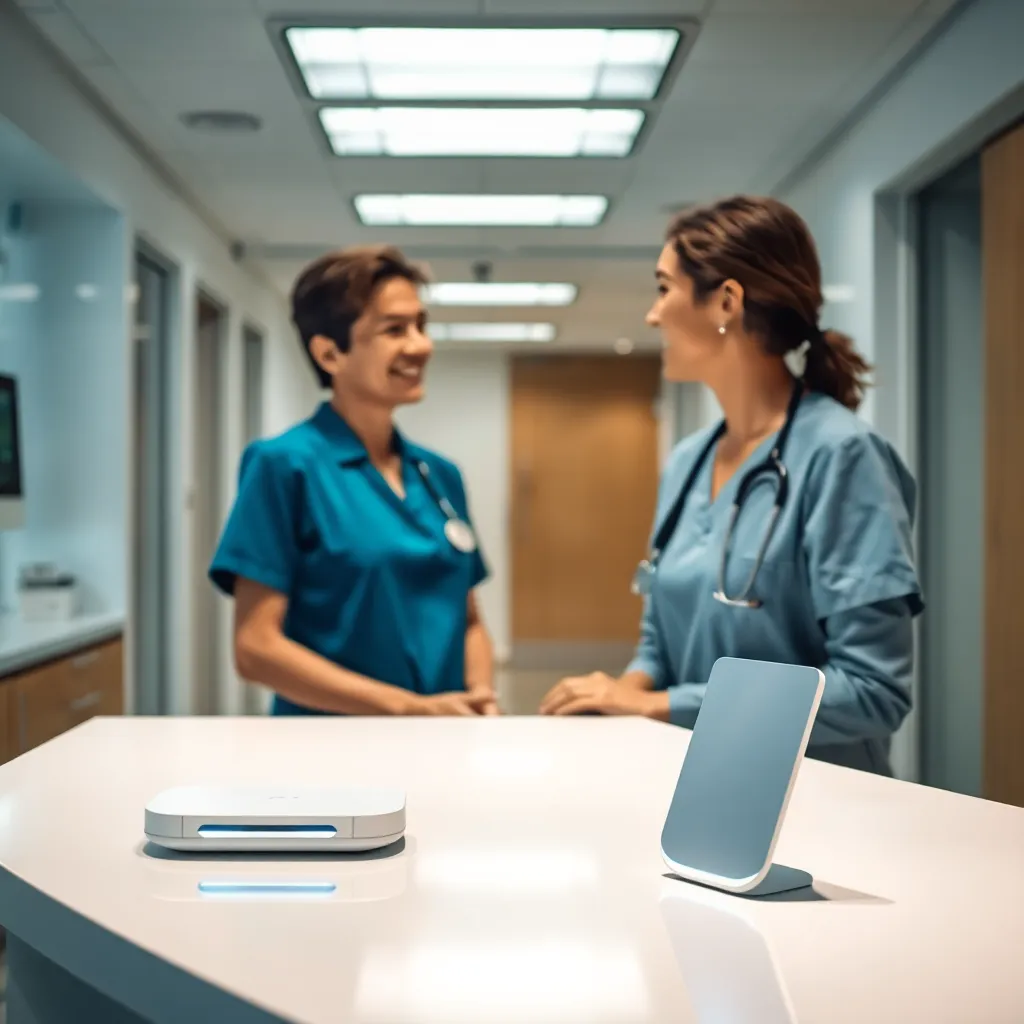
The AI Revolution at the Front Desk: How OpenAI's Workspace Agents and Privacy Filter Are Transforming Patient Intake
Learn how AI voice agents powered by OpenAI's Workspace Agents and Privacy Filter are revolutionizing healthcare for efficient intake and secure data processing.
Oliver Wimmer ·
The first point of contact in any medical facility is often the front desk. This is where expectation meets urgency. From scheduling appointments and answering questions to the initial assessment of symptoms, the tasks are varied, complex, and time-sensitive. In a world where healthcare is under increasing strain, front-desk staff face enormous pressure. But what if an intelligent assistant could shoulder a large part of this burden, allowing human staff to focus on what they do best: empathy and complex problem-solving?
This is exactly where the current wave of artificial intelligence comes in. Recent innovations from OpenAI, such as "Workspace Agents" and the "Privacy Filter," promise to make this vision a reality faster than we could have imagined just a short time ago. In 2026, we are seeing rapid development in specialized AI agents that can not only converse but are also embedded in corporate processes and process data intelligently-all with an unprecedented focus on data protection.
The Challenge at the Healthcare Front Desk
The reception area in clinics and Arztpraxen (medical practices) is the bottleneck of the healthcare system. High call volumes, repetitive questions, the urgency of patient requests, and the constant need for accurate documentation present administrative staff with enormous challenges. Long wait times on the phone or in the waiting room are the result, which not only reduces patient satisfaction but also leads to staff frustration. Manual triage-assessing the urgency of a patient's request-is prone to error and ties up valuable time that could be better used for direct patient care. Added to this is the ever-present need to protect sensitive patient data, which further complicates any digital transformation in healthcare.
AI Voice Agents as a Game Changer
We have been talking about the potential of AI voice agents to automate routine tasks for some time. But with the latest developments, we are far beyond simple chatbots. Modern AI voice agents, like those developed by Servus KI, are capable not only of understanding natural language but also of responding intelligently and handling complex processes autonomously. They can:
- Schedule and reschedule appointments: Around the clock and without human intervention.
- Answer frequently asked questions: From consultation hours to directions.
- Collect patient data: Securely and in a structured format for further processing.
- Perform initial assessments: Based on structured questions and answers.
OpenAI's Workspace Agents: The Intelligent Co-Pilot at the Front Desk
The introduction of OpenAI's Workspace Agents marks a turning point. These new agents are more than just improved GPTs; they are designed to integrate seamlessly into existing corporate systems-whether that is a CRM, an elektronisches Patientenaktensystem (ePA, or electronic patient record system), or other internal tools. For the healthcare sector, this means enormous relief:
- Automated workflows: A Workspace Agent can, for example, take a call, verify the patient's identity, ask about symptoms, note the information directly in the ePA, and, based on predefined protocols, suggest and book an appointment with the appropriate Facharzt (medical specialist)-all in one fluid process.
- Intelligent routing: In more complex or urgent cases, the agent can summarize the collected information and connect the patient with the right human contact, who is then already fully informed.
- Real-time support: They act as "AI office interns" working in the background, gathering information and making it immediately available to human staff as needed to increase the efficiency of the entire front-desk operation.
This transforms the front desk from a reactive to a proactive service point that anticipates and addresses patient needs.
The Privacy Filter: Security for Sensitive Health Data
A crucial factor in healthcare is data protection. Patient information is extremely sensitive and subject to the strictest regulations, such as the GDPR or HIPAA. This is where OpenAI's newly introduced "Privacy Filter" comes into play. As an open-source model for on-device data sanitization, it allows personal information to be removed from corporate datasets before they are processed by larger models or transmitted beyond secure environments.
For the use of AI in healthcare, this is revolutionary:
- Privacy by design: The Privacy Filter ensures that only anonymized or non-personally identifiable data is used for analysis or interaction with external AI models. This minimizes the risk of data leaks and ensures compliance.
- Building trust: Patients and healthcare facilities can trust that their sensitive information is protected, even when interacting with advanced AI systems.
- Enabling innovation: By proactively addressing data protection concerns, the Privacy Filter opens the door for the broader use of AI in areas previously considered too sensitive due to privacy risks.
Intelligent Patient Triage: Faster, Safer, More Human
The combination of advanced AI voice agents, the integrating capabilities of Workspace Agents, and the data security of the Privacy Filter enables an entirely new dimension of patient triage:
- Complete preliminary data collection: Patients can describe their symptoms and concerns in detail before any personal contact-either over the phone or via an online portal supported by the voice agent.
- Structured symptom inquiry: The AI agent asks targeted questions to get a comprehensive picture of the situation, similar to an initial human consultation, but without the wait time.
- Urgency assessment: Based on the collected data and predefined medical guidelines, the agent can make an initial assessment of urgency and direct the patient accordingly-whether to the emergency room, to a consultation, or with a suggestion for self-medication.
- Optimized resource planning: The clinic or practice receives pre-processed information, which significantly simplifies appointment scheduling and assignment to the right specialists, reducing wait times for all patients.
- Staff relief: Human staff are relieved of routine inquiries and can focus on more complex cases, personal care, and empathetic communication, where human compassion is irreplaceable.
This not only leads to more efficient patient intake but also significantly improves the quality of initial care and patient satisfaction. Healthcare staff can focus on the truly important, human interactions while the AI carries the administrative burden.
The transformation of healthcare through intelligent AI agents is only just beginning. But recent advances show that we are well on our way to creating more efficient, accessible, and human healthcare for everyone-a vision that Servus KI is actively helping to shape.
❓ FAQ
Q: What are OpenAI's Workspace Agents in the context of healthcare? ✅ Workspace Agents are advanced AI agents that can seamlessly integrate into corporate systems to automate complex workflows and act as intelligent co-pilots for administrative tasks at the front desk, such as scheduling appointments or collecting data.
Q: How does the Privacy Filter ensure data protection when using AI in healthcare? ✅ The Privacy Filter is an open-source model for on-device data sanitization that removes personal information from datasets before they are processed by larger AI models or transmitted beyond secure environments, protecting sensitive patient data and ensuring compliance with data protection regulations.
Q: Can AI voice agents completely replace human front-desk staff? ✅ No, AI voice agents are designed to support and relieve human staff by automating routine tasks. They allow personnel to focus on more complex cases, personal care, and empathetic communication, where human compassion is irreplaceable.
Q: What specific benefits does intelligent patient triage through AI offer? ✅ It leads to shorter wait times, a more precise initial assessment of urgency, better resource planning, and significant relief for medical staff, which overall increases patient satisfaction and the facility's efficiency.
Q: How current are these technologies in 2026? ✅ The concepts of Workspace Agents and the Privacy Filter are cutting-edge developments that, in 2026, have the potential to fundamentally change the way companies, and healthcare in particular, interact with AI.
The future of healthcare is already here. Discover how Servus KI can support your organization with tailored AI voice agents and conversational AI products to create more efficient, patient-centered, and privacy-compliant care. Contact us today for a personalized consultation.
Oliver Wimmer is Head of Communication at Servus KI and guides companies through digital transformation.