
You do not listen in on every call. You can still see how it went.
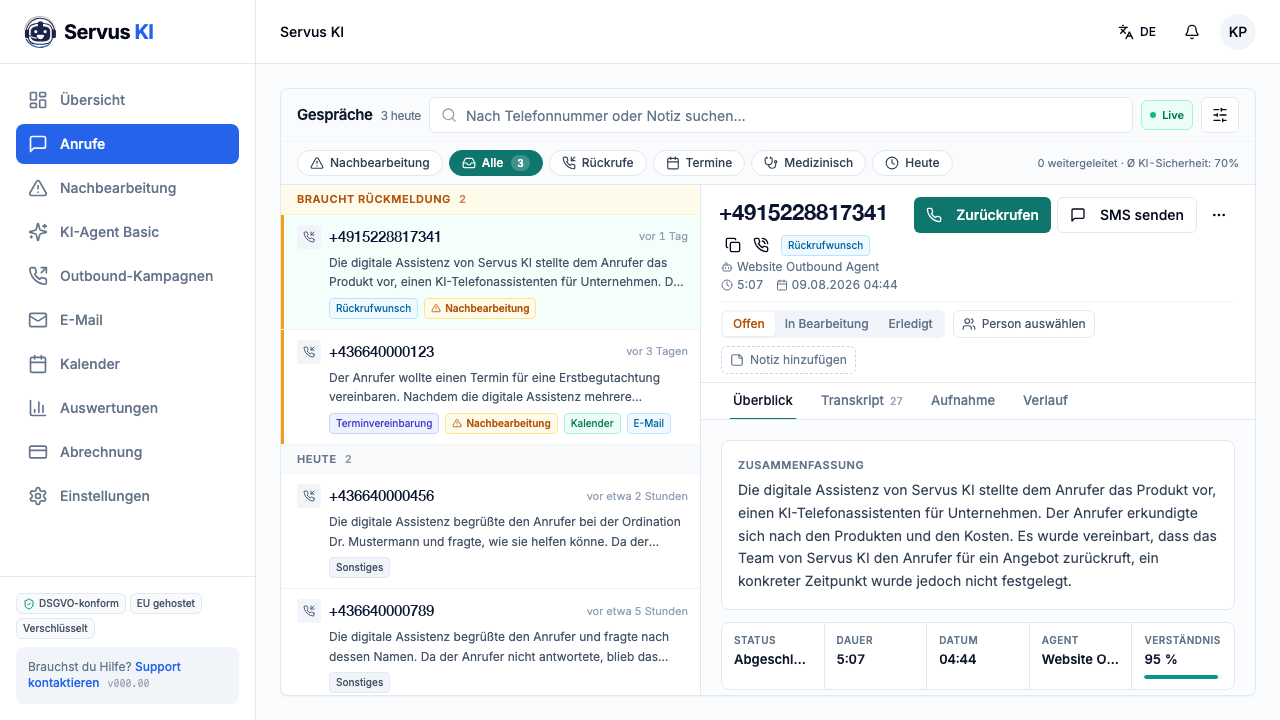
Servus KI rates every call against criteria you define and shows you the result in the call list. You can see at a glance which calls went smoothly and which are worth looking at.
What is behind it
01
You define what a good call is
Not us. You set the criteria that matter in your practice: was the name recorded? Was an appointment booked? Was the call transferred when something was unclear? Every criterion is a question that is either met or not.
02
Every call is checked, not every tenth
The rating runs automatically after each call. There is no sampling and no member of staff listening to recordings. Even the calls at 21:40 are rated by the next morning.
03
One figure that shows the trend
Next to the rating of the individual call you see the average across all calls. If it falls, something is wrong, usually a practice rule that has changed and has not been entered yet.
04
Anything unusual is at the top
Calls that did not meet your criteria land in the follow-up list instead of disappearing into the pile. You work through the exceptions, not the rule.
How it works in practice
- 1
Mrs Berger calls at 8:40 and would like a follow-up appointment. Both lines are busy, so Servus KI answers.
- 2
After the call Servus KI checks: name recorded, request understood, appointment booked. The call gets a high score and the category "appointment booking".
- 3
At 8:52 someone calls with a strong dialect and the request stays unclear. Servus KI transfers the call and marks it for follow-up. Your assistant sees exactly that one call during the morning and calls back, instead of listening through twelve recordings.
With and without
Today
- You find out about a call that went wrong when somebody complains.
- Whether the AI is doing a good job is a gut feeling.
- To be sure, somebody would have to listen to recordings.
- If a practice rule changes, it becomes obvious eventually.
With Servus KI
- You see it the same morning in the list.
- It is a figure you can follow over weeks.
- You look at the few calls that stand out.
- The average drops and you know immediately where to adjust.
Related
Frequently asked questions
Do I have to set up the rating criteria myself?
No. We enter them together during setup. You tell us what matters in your practice and we translate it into criteria that can be checked. You can change them at any time.
Does Servus KI rate medical content?
No. Only the course of the call is checked: whether the agreed details were recorded and whether your rules were followed. No medical assessment takes place.
What happens to calls that were rated badly?
They land in the follow-up list. There you see the summary, the transcript and, if activated, the recording, and you can call back or send an SMS straight from that view.
Who can see the ratings?
Only logged-in users from your practice. The data is held on servers in the EU and a data processing agreement is available.